McCurdy, Stephen A. "Epidemiology of Disaster - The Donner Party
(1846-1847)." Western Journal of Medicine (April 1994): 338-342.
This article, from the Western Journal of Medicine, takes a very different approach than the majority of my other cited sources. Stephen McCurdy uses just five short pages to describe a breakdown of mortality in the Donner Party. These mortality statistics focus mainly on gender, age groups, and the survival rate of those whom had present family or loved ones, and those that didn't. Through statistics and graphs, it is made very clear that the strongest survivors were children, woman, and those who had family available in such a great time of need. I found this article very helpful in understanding demographic response to such horrific events, and I now have an exciting new angle to investigate in my interview process.
Diamond, Jared. "Living Through the Donner Party." Discover Magazine (March
1992): 100-107
"Living Through the Donner Party" explores similar themes to the Western Journal of Medicine article I cited, and it explores those themes with even more depth. Mr. Diamond displays similar statistics to that of Shephen McCurdy, but he adds a much more exploratory edge to the numbers. In attempting to find out why women fared so much better than men on the journey, he points out the shortcomings of men in stressful situations, such as a tendency toward violence, as their possible downfall. A man's high metabolic rate and lower body fat count is also considered as a culprit for a much quicker demise. Even more striking, the non-family affiliated members of the group were all men, and almost every one of them died. I believe that this article brings a very curious, yet well informed set of arguments to the table that will prove to be very helpful.
Walker, Cameron. "Donner Party" Hearth Yields Bones; DNA Analysis Planned."
National Geographic (July 2004): 1-2.
This National Geographic article's main focus is an in-field study on archeological elements left behind at the Donner camp near Alder Creek. Cameron Walker explain the significance of finding a hearth from a fire in the vicinity of the spot suspected to be the location where the Donner Party spent that infamous winter. Scientists explain that evidence of cannibalism, or even a better understanding of day to day life at Alder Creek, could help us separate myth from the truth. Walker explains that the archeologists found evidence, in the form of burnt remains of human bone, at the site of the hearth. A study is to be conducted where scientist will attempt to match DNA from the remains with DNA from remaining Donner Party descendants. I found this article helpful for placing something tangible at Alder Creek, but a follow-up article would be of absolute value.
Murphy, Virginia Reed. "Across the Plains in the Donner Party: 1846-1847."
Century Magazine (July 1891): 1-20
"Across the Plains in the Donner Party" started as an actual journal from a member of the Donner Party, and that alone should give it merit as a valuable resource. This set of journals is separated by date, and it is written in a very matter of fact type of fashion. To be provided with a time line from a source present at the time gives this journal's dead pan delivery a personal touch. An even more human touch is provided when Virginia opens up about events and remembers them through the eyes of a twelve year old child. Virginia describes herself as fearful and her mother as frail, and those descriptions make the end results of the stronger woman and children surviving even more compelling.
Rosen, Daniel M. "Log Entries for September, 1846." 2009.
http://www.donnerpartydiary.com/SEP46.HTM (April 24, 2011).
Though not a proven scholarly resource, Daniel M. Rosen's donnerpartydiary.com is quite a valuable commodity to have available. This website works through an in-depth chronology of the Donner Party's journey using diary entries left behind by actual members of the party as sources. The section of Rosen's story that I found most helpful was the one describing September 1846 and the crossing of the Great Salt Desert. The hardships of crossing the desert seem to be a good prelude to events coming later in the story. The journey had to be hard in previous sections, but the thirst, hunger, loss of time, and loss of resources described in this section could have been the very worst to happen in a lesser tale. I feel reading this section of donnerpartydiaries has given me a few ideas on adding foreboding elements to my paper.
Weiser, Kathy. "Old West Legends - The Donner Party Tragedy." July 2010.
http://www.legendsofamerica.com/ca-donnerparty.html (April 23, 2011).
Kathy Weiser gives a concise, four page explanation of the Donner Party and their exploits. Though legendsofamerica.com doesn't provide me with too many new angles for research, this article does provide me with a nice template for a research paper. Though I do plan on ending up with a lengthier final product, a summary such as this one gives me a good idea of where certain fatty aspects of the story could be trimmed down. One idea this article has helped me remain interested in is where to point the finger of blame. Was Lansford W. Hastings and his false route to blame, or was it James Donner's refusal of advice from his friend James Clyman that did the party in? This is a theme that I intend to explore more in my interview process.
Tuesday, April 26, 2011

Tuesday, April 19, 2011
Annotated Bibliography of Four Research Sources
McNeese, Tim. The Donner Party: A Doomed Journey. New York: Chelsea
House (2009): 20-27.
This section of "A Doomed Journey" highlights the basics perks to an exodus to the west and the shift of movement from Oregon toward California. McNeese explains the initial Oregon boom and the fear of the road to California being too difficult. He then reveals that the route to California had been improved and traveled upon, and future emigrant interest in the new route began to rise. McNeese then introduces us to Lansford W. Hastings, the author of "The Emigrants' Guide to Oregon and California," a confident man who had an idea for an alternate route to California that he had not already traveled. This author did a very good job setting up both the excitement of western movement and planting the seed for ultimate demise.
Stewart, George R. Ordeal By Hunger: The Story of the Donner Party. New
York: Houghton Mifflin (1988): 31-39
This chapter of Stewart's book, entitled "The Wahsatch," describes the hardships of the Hastings Cutoff. Stewart does a great job describing the difficult and slow paced chore that the Cutoff turned out to be. The author describes narrow canyons, thick brush, enormous boulders blocking the path, and lost oxen, wagons, and party members. The chapter shows the party go from jovial emigrants to a tired pack of lost soul with nothing but contentment for their mentor. Most importantly are the themes of crucial time lost. With the loss of ground gained a pace of only a mile and a half a day, the Hastings Cutoff may have been the leading factor in the eventual doom of the Donner Party.
Limburg, Peter R. Deceived: The Story of the Donner Party. Pacifica,
California: International Publishing Services (1998): 111-119.
Limburg paints a picture of a party separated in the chapter appropriately named "Snowbound." Only mere hours too late for a safe passage between two mountains the Donners meet the biggest challenge of the journey up to that point. The party finds themselves in a storm that could have been avoided without all the previous lost time in their expedition. The group is split into two camps, one who made it over the pass to a lake with a cabin, and the other who was trapped just below the pass with only the supplies they had brought along and clothes on their backs. Limburg does seem to stress the point that cabin or no, the families would be stuck in their respective camps all winter, due to the extremity of the storm experienced.
Rarick, Ethan. Desperate Passage: The Donner Party's Perilous Journey
West. New York: Oxford University Press (2008): 190-196.
Rarick seems to explore more into the horror element of the story than the more historically focused works cited. I find this important, though, seeing as this is the highlight of the legend for most readers. In this chapter "Gruesome Sights" a scene is described where a rescue crew from California stumbles upon an unexpected sight. The author describes, in horrific detail, that the group of rescuers was forced to bear witness to families driven to cannibalism. Most notably Rarick describes the events of children devouring the flesh of their own parent, and how that was the reason more children survived the situation than any adult group. Only one family is said not to have engaged in the act, and this only adds to the intrigue of the underlying evil versus necessity argument.
House (2009): 20-27.
This section of "A Doomed Journey" highlights the basics perks to an exodus to the west and the shift of movement from Oregon toward California. McNeese explains the initial Oregon boom and the fear of the road to California being too difficult. He then reveals that the route to California had been improved and traveled upon, and future emigrant interest in the new route began to rise. McNeese then introduces us to Lansford W. Hastings, the author of "The Emigrants' Guide to Oregon and California," a confident man who had an idea for an alternate route to California that he had not already traveled. This author did a very good job setting up both the excitement of western movement and planting the seed for ultimate demise.
Stewart, George R. Ordeal By Hunger: The Story of the Donner Party. New
York: Houghton Mifflin (1988): 31-39
This chapter of Stewart's book, entitled "The Wahsatch," describes the hardships of the Hastings Cutoff. Stewart does a great job describing the difficult and slow paced chore that the Cutoff turned out to be. The author describes narrow canyons, thick brush, enormous boulders blocking the path, and lost oxen, wagons, and party members. The chapter shows the party go from jovial emigrants to a tired pack of lost soul with nothing but contentment for their mentor. Most importantly are the themes of crucial time lost. With the loss of ground gained a pace of only a mile and a half a day, the Hastings Cutoff may have been the leading factor in the eventual doom of the Donner Party.
Limburg, Peter R. Deceived: The Story of the Donner Party. Pacifica,
California: International Publishing Services (1998): 111-119.
Limburg paints a picture of a party separated in the chapter appropriately named "Snowbound." Only mere hours too late for a safe passage between two mountains the Donners meet the biggest challenge of the journey up to that point. The party finds themselves in a storm that could have been avoided without all the previous lost time in their expedition. The group is split into two camps, one who made it over the pass to a lake with a cabin, and the other who was trapped just below the pass with only the supplies they had brought along and clothes on their backs. Limburg does seem to stress the point that cabin or no, the families would be stuck in their respective camps all winter, due to the extremity of the storm experienced.
Rarick, Ethan. Desperate Passage: The Donner Party's Perilous Journey
West. New York: Oxford University Press (2008): 190-196.
Rarick seems to explore more into the horror element of the story than the more historically focused works cited. I find this important, though, seeing as this is the highlight of the legend for most readers. In this chapter "Gruesome Sights" a scene is described where a rescue crew from California stumbles upon an unexpected sight. The author describes, in horrific detail, that the group of rescuers was forced to bear witness to families driven to cannibalism. Most notably Rarick describes the events of children devouring the flesh of their own parent, and how that was the reason more children survived the situation than any adult group. Only one family is said not to have engaged in the act, and this only adds to the intrigue of the underlying evil versus necessity argument.
Monday, March 28, 2011
More fun with logical fallacies!


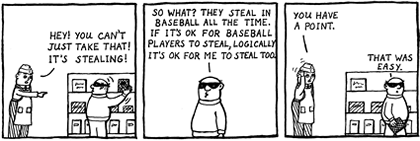
Above I have posted three short editorial comics. Each of the three illustrations contain a separate type of logical fallacy. I chose these three examples, in particular, because they each seem to present a fallacy in a very raw form.
The first comic shows a man with a suit and a briefcase choosing between two doors. One door is labeled "fulfillment without wealth," and the other is labeled "wealth without fulfillment." This classic scenario is a prime example of a false dilemma. If the man chooses one door he will be rich, but somewhat empty inside. If he chooses the other door, he will be poor, but happy. Who is to say a man can't be both rich and happy? The man is handed two choices here, but he should really have a choice between at least four doors.
The second example shows a penguin thinking to himself, "Penguins are black and white. Some old TV shows are black and white. Therefore, some penguins are old TV shows." The penguin's thoughts are begging the question. He finds his conclusion through his own assumption. He is black and white, so if something else is black and white, maybe he is something else.
The last example, is a comic strip showing a man being addressed for stealing off a store shelf by an employee of the store. When told what he is doing is wrong, the thief replies, "So what? They steal in baseball all the time. If it's ok for baseball players to steal, logically it's ok for me to steal too." This is an example of equivocation. Stealing is not a crime in baseball, but stealing merchandise from a store is. Even though the same word is used in both arguments, it is given a different connotation, which can be misleading.
Research Paper Brainstorming
Ideas:
1. Pacific Crest Trail
2. Prohibition
3. Birth of Hip Hop
4. Founding of The National Park Service
5. The Donner Party
6. Yellowstone Super Volcano
7. Carlsbad Caverns
8. First Ascent of Mt. Everest
 Idea: Prohibition
Questions:
What events occurred in order for the government to make Prohibition a law?
What were the negative and positive results?
How did speakeasies operate?
What eventually led to Prohibition being repealed?
 Idea: Founding of The National Park Service
Questions:
Who are considered the founding fathers of the National Park Service?
What areas were being threatened before the Park Service formed?
What wildlife was being threatened before the Park Service formed?
What was the first National Park?

Questions:
Who exactly was the Donner Party?
What caused their expedition to go awry?
Did they actually turn to cannibalism?
What evidence has been found to support this claim?
 Idea: Carlsbad Caverns
Questions:
How did the caverns form?
Who were the first humans to explore the caverns?
What is the significance of the bat population in the park?
Why are Carlsbad Caverns and Guadalupe Mountains not a single park?
 Idea: First Ascent of Mt. Everest
Questions:
Who was the first to summit the worlds biggest mountain?
What cultural significance did this event have?
Was the ascent assisted by Sherpa or provided oxygen?
How long before the second attempt?
1. Pacific Crest Trail
2. Prohibition
3. Birth of Hip Hop
4. Founding of The National Park Service
5. The Donner Party
6. Yellowstone Super Volcano
7. Carlsbad Caverns
8. First Ascent of Mt. Everest
Questions:
What events occurred in order for the government to make Prohibition a law?
What were the negative and positive results?
How did speakeasies operate?
What eventually led to Prohibition being repealed?
Questions:
Who are considered the founding fathers of the National Park Service?
What areas were being threatened before the Park Service formed?
What wildlife was being threatened before the Park Service formed?
What was the first National Park?

Idea: The Donner Party
Questions:
Who exactly was the Donner Party?
What caused their expedition to go awry?
Did they actually turn to cannibalism?
What evidence has been found to support this claim?
Questions:
How did the caverns form?
Who were the first humans to explore the caverns?
What is the significance of the bat population in the park?
Why are Carlsbad Caverns and Guadalupe Mountains not a single park?
Questions:
Who was the first to summit the worlds biggest mountain?
What cultural significance did this event have?
Was the ascent assisted by Sherpa or provided oxygen?
How long before the second attempt?
Tuesday, March 15, 2011
Response to logical fallacies expressed in Daily Show clip
dailyshow.immigrant-disease
The Daily Show's staff of writers are experts at pointing out logical fallacies in political media. Naturally, when facing a topic as controversial as illegal immigration, they are working with a wide array of potential firepower.
The first comedic jab, through the use of logical fallacies, is when the guest is introduced as a "resident expert." When the commentator, John Hodgman, is presented as a leading authority in the field of immigration, he cites his own work, "My Grandparents Were Slav Or Something," as proof of his authority. This is a glaring example of a logical fallacy appealing to an authority that may not be an expert at all. If the man is not certain of his own past involving immigration, then what makes him an authority in the first place?
The next fallacy presented in this clip, is a clear argument for ignorance. After shooting to clips of other false authorities on the subject, who are all in agreement that immigrants are re-introducing older problems with disease to the United States, Hodgman vomits the bold claim, "Illegal aliens have tuberculosis and leprocy!" Since there has been no opposing argument or physical proof presented to Hodgman contrary to his view of the subject, he feels warranted in blurting out such a strong statement. Just because something is not proven false, doesn't mean it is true.
After Hodgman makes this statement, the satirist takes his argument further and further down a slippery slope. When evidence is finally produced, taming the numbers and figures presented by our so-called experts, they begin to introduce scare tactics. Suddenly, immigrants are no longer just diseased. They are gang members, drunk drivers, drug addicts, and rapists. None of these claims are warranted as hard evidence. We are expected to believe that even if we are not effected by disease, we may still, for some reason, be in danger.
Logical fallacies are everywhere in today's media. We are lucky to have comedians, such as Jon Stewart or John Hodgman, to keep us on our toes and able to point out these untruths.
The Daily Show's staff of writers are experts at pointing out logical fallacies in political media. Naturally, when facing a topic as controversial as illegal immigration, they are working with a wide array of potential firepower.
The first comedic jab, through the use of logical fallacies, is when the guest is introduced as a "resident expert." When the commentator, John Hodgman, is presented as a leading authority in the field of immigration, he cites his own work, "My Grandparents Were Slav Or Something," as proof of his authority. This is a glaring example of a logical fallacy appealing to an authority that may not be an expert at all. If the man is not certain of his own past involving immigration, then what makes him an authority in the first place?
The next fallacy presented in this clip, is a clear argument for ignorance. After shooting to clips of other false authorities on the subject, who are all in agreement that immigrants are re-introducing older problems with disease to the United States, Hodgman vomits the bold claim, "Illegal aliens have tuberculosis and leprocy!" Since there has been no opposing argument or physical proof presented to Hodgman contrary to his view of the subject, he feels warranted in blurting out such a strong statement. Just because something is not proven false, doesn't mean it is true.
After Hodgman makes this statement, the satirist takes his argument further and further down a slippery slope. When evidence is finally produced, taming the numbers and figures presented by our so-called experts, they begin to introduce scare tactics. Suddenly, immigrants are no longer just diseased. They are gang members, drunk drivers, drug addicts, and rapists. None of these claims are warranted as hard evidence. We are expected to believe that even if we are not effected by disease, we may still, for some reason, be in danger.
Logical fallacies are everywhere in today's media. We are lucky to have comedians, such as Jon Stewart or John Hodgman, to keep us on our toes and able to point out these untruths.
Tuesday, March 8, 2011
Research on controversies surrounding Park51
stanford.edu
gulfnews.com
time.com
globalresearch.ca
Park51 (Cordoba Center)
gulfnews.com
time.com
globalresearch.ca
Park51 (Cordoba Center)
This Stanford University article is the one that seems to dig the deepest to find the root of the controversy. This article contains insight into the fact that the root of this debate may lie in the original name of the project, The Cordoba House. Muslim influence is explained to have been at an all-time high during this period. Although Christians and Jews lived side by side with Muslims at this time, there were certain regulations that place the outsider lower in society. In making reference to a time that Muslims were considered a higher caste of citizens than other religions, the project's creators seem to have placed a target on their own heads. I found the history provided here very helpful, and the lack of political bias refreshing.
Roots of American rage over Park 51
The second article puts the blame on the growing separation of understanding between the general American and Islam cultures. It explains that we, as Americans, have gained a general distrust in Muslims. Close to half of the United States population is cited as saying that the civil liberties of Muslims in the United States of America should be limited. It is assumed that our view of Islam versus Islamic extremism has been substantially blurred. An important point about avoiding generalization is made here, and I feel that making an educated assumption about this subject should be made while avoiding outside politics.Ground Zero: Exaggerating the Jihadist Threat
The third article presented makes less of a point about the general growing fear of Islam and focuses more on the idea behind the building's particular placing. We may not be anti-Muslim as a nation, but we do agree that placing a worship center of this persuasion on this particular lot is disrespectful. A point is made to differentiate the center from simply a place of worship by boasting the presence of a "swimming pool, basketball court, auditorium, library, day-care facility, restaurant and cooking school." I enjoy the educated approach taken in this article. It seems to remain neutral, while still citing material from either side.The Muslim Mosque at Ground Zero and Freedom of Religion in America
The last article is very overblown, but it seems to come down to the simplest explanation in its purest form. This article leans on the United States Constitution. We, as Americans, are guaranteed the right to freedom of religion. Regardless of your individual background as a citizen, our rights are quite precious. Why should you not lean on them? The point of this one is, regardless of your view of Islam, Islamic Americans have the right to worship where and whenever they want. My main gripe with article was how parties were labeled in a non-partisan review. A point could stand out more without label given this kind of argument.
Tuesday, March 1, 2011
Reflection on two opposing articles about assisted suicide
I remember hearing about him as a child. He was truly a paradox of a man. On one side of the coin he wore a white coat and a stethescope. If you flipped the coin over the man held a fatal needle over a dying patient. A doctor who killed people. Who had heard of such a thing? The only thing cementing him as an evil mastermind was a true wildcard, though. The people he killed wanted to die. Some people called him a monster, some called him a saint, but the name they all seemed to agreed on was Kevorkian.
I can't remember feeling any certain way about the doctor at the time. I was a child born in Oklahoma who was growing up in Texas. I had people like Timothy McVeigh and David Koresh to worry about. Still to this day, I have yet to make a desicion for or against assisted suicide. Somehow, though, the subject has entered my life again. It is now becoming a hot topic in Montana.
To look at this controversial topic fairly, I have located two editorials online. These opposing articles are very different in many ways, and are linked below for easy reference.
Pro Assisted Suicide
We have a right to choose our end
Anti Assisted Suicide
Physician-assisted suicide: a recipe for elder abuse and the illusion of personal choice
Our first editorial is coined by Gary Bauslaugh and is titled "We have a right to chose our end." This particular article is short and to the point. It starts by generalizing the views of Canadians as being almost unanimously for assisted suicide. Bauslaugh delivers his ideas as a collective Canadian audience called "We." He makes a statement suggesting that there is nothing wrong with wanting to live a long life, but he quickly counters with strong words about the forbidding opposition. Mr. Bauslaugh paints a picture of a disabled man relieved of his ailments by assisted suicide as a painless thing, and calls the alternative "grisly" and "disturbing." The views of the author in this editorial are clear, but the lack of evidence and force-fed bias do little to win over the undecided reader.
The second editorial "Physician-assisted suicide: a recipe for elder abuse and the illusion of personal choice" by Alex Schadenberg offers a very different approach to the subject. Instead of bombarding the reader with bias right off the bat, it allows information to slowly gather into an opinion. This editorial is broken up into several sections,and each of these sections borrow from cited works about the subject. This article rarely attempts to grab for pure human emotion, but when it does it is mostly effective. One example would be a "terminal" patient that could have chosen a suicide solution when it was projected that she had only six months left to live. She denied the solution, and upon trying the alternative, lived to see ten plus more years. One of the main points of this anti-assisted suicide publishing is to make the reader aware of the possible abuse of the elderly. In suggesting suicide as an easy way out to a person who does not believe they have much left to live for, a selfish person may be able to immorally benefit from that elderly person giving in. The author seems to believe dignity belongs to a person regardless of age or disability, and assisted suicide may diminish that dignity.
While I do not necessarily agree with the points given in the second selection, I do agree that the delivery has much more potential to impact a previously uninformed mind. These two authors agree on almost nothing. One editorial was based on pure passion, and the other was a belief formed from cited research. While the later method may not be as fun to read, it is much more helpful in getting a basic point across.
I am still a child at heart, and I have yet to come to a conclusion on what to believe about this issue. One thing my inner child does relate to though, is telling me that you are right, can only make me want to prove you wrong.
I can't remember feeling any certain way about the doctor at the time. I was a child born in Oklahoma who was growing up in Texas. I had people like Timothy McVeigh and David Koresh to worry about. Still to this day, I have yet to make a desicion for or against assisted suicide. Somehow, though, the subject has entered my life again. It is now becoming a hot topic in Montana.
To look at this controversial topic fairly, I have located two editorials online. These opposing articles are very different in many ways, and are linked below for easy reference.
Pro Assisted Suicide
We have a right to choose our end
Anti Assisted Suicide
Physician-assisted suicide: a recipe for elder abuse and the illusion of personal choice
Our first editorial is coined by Gary Bauslaugh and is titled "We have a right to chose our end." This particular article is short and to the point. It starts by generalizing the views of Canadians as being almost unanimously for assisted suicide. Bauslaugh delivers his ideas as a collective Canadian audience called "We." He makes a statement suggesting that there is nothing wrong with wanting to live a long life, but he quickly counters with strong words about the forbidding opposition. Mr. Bauslaugh paints a picture of a disabled man relieved of his ailments by assisted suicide as a painless thing, and calls the alternative "grisly" and "disturbing." The views of the author in this editorial are clear, but the lack of evidence and force-fed bias do little to win over the undecided reader.
The second editorial "Physician-assisted suicide: a recipe for elder abuse and the illusion of personal choice" by Alex Schadenberg offers a very different approach to the subject. Instead of bombarding the reader with bias right off the bat, it allows information to slowly gather into an opinion. This editorial is broken up into several sections,and each of these sections borrow from cited works about the subject. This article rarely attempts to grab for pure human emotion, but when it does it is mostly effective. One example would be a "terminal" patient that could have chosen a suicide solution when it was projected that she had only six months left to live. She denied the solution, and upon trying the alternative, lived to see ten plus more years. One of the main points of this anti-assisted suicide publishing is to make the reader aware of the possible abuse of the elderly. In suggesting suicide as an easy way out to a person who does not believe they have much left to live for, a selfish person may be able to immorally benefit from that elderly person giving in. The author seems to believe dignity belongs to a person regardless of age or disability, and assisted suicide may diminish that dignity.
While I do not necessarily agree with the points given in the second selection, I do agree that the delivery has much more potential to impact a previously uninformed mind. These two authors agree on almost nothing. One editorial was based on pure passion, and the other was a belief formed from cited research. While the later method may not be as fun to read, it is much more helpful in getting a basic point across.
I am still a child at heart, and I have yet to come to a conclusion on what to believe about this issue. One thing my inner child does relate to though, is telling me that you are right, can only make me want to prove you wrong.
Subscribe to:
Comments (Atom)