

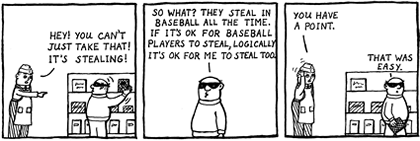
Above I have posted three short editorial comics. Each of the three illustrations contain a separate type of logical fallacy. I chose these three examples, in particular, because they each seem to present a fallacy in a very raw form.
The first comic shows a man with a suit and a briefcase choosing between two doors. One door is labeled "fulfillment without wealth," and the other is labeled "wealth without fulfillment." This classic scenario is a prime example of a false dilemma. If the man chooses one door he will be rich, but somewhat empty inside. If he chooses the other door, he will be poor, but happy. Who is to say a man can't be both rich and happy? The man is handed two choices here, but he should really have a choice between at least four doors.
The second example shows a penguin thinking to himself, "Penguins are black and white. Some old TV shows are black and white. Therefore, some penguins are old TV shows." The penguin's thoughts are begging the question. He finds his conclusion through his own assumption. He is black and white, so if something else is black and white, maybe he is something else.
The last example, is a comic strip showing a man being addressed for stealing off a store shelf by an employee of the store. When told what he is doing is wrong, the thief replies, "So what? They steal in baseball all the time. If it's ok for baseball players to steal, logically it's ok for me to steal too." This is an example of equivocation. Stealing is not a crime in baseball, but stealing merchandise from a store is. Even though the same word is used in both arguments, it is given a different connotation, which can be misleading.

No comments:
Post a Comment